
My son Ethan is the reason I'm writing this.
Not my research. Not my career. Not the 22 years I spent studying growth plate biology.
Ethan.
Because I watched him sit at the 5th percentile for three consecutive years, and everything I knew — every study I'd published, every formula I'd reviewed — couldn't move that number.
And when I finally figured out why, I wanted to throw my diploma in the trash.
Because the answer had been in the published research the entire time.
The growth supplement industry just chose not to use it.
My name is Dr. James Whitmore. I've spent 22 years as a pediatric nutritional biochemist studying how children's bones grow longer — not stronger, not denser, but physically longer.
I've published research on growth plate biology. I've consulted for three supplement companies. I've reviewed more children's growth formulas than I can count.
And I'm about to tell you something none of those companies want you to hear.
But first — the night that changed everything.
"He Used to Be the Loudest Kid in the Room."

Ethan was always small.
Not dramatically. Not the kind of small that triggers referrals. Just consistently, visibly the shortest boy in every class photo, every soccer lineup, every birthday party group shot.
The kind of small where strangers make comments.
"Oh, how old is he? Really? He's so tiny for his age!"
My wife Sarah would smile and change the subject. But I could see her jaw tighten every time. That micro-flinch she thought nobody noticed.
By age 6, Ethan was in the 5th percentile. By age 8, still the 5th. By age 9, the 5th.
Three years. No movement. The growth chart looked like someone had drawn a straight line with a ruler while every other child's line curved upward around it.
His pediatrician said the same thing at every visit.
"He's on his curve. Be patient."
Sarah heard those words eleven times over four years.
She'd nod in the office. Smile. Thank the doctor.
Then she'd cry in the car. Not dramatic sobs — the quiet kind. Gripping the steering wheel, staring straight ahead, tears rolling without permission while Ethan sat in the back playing a game on her phone, completely unaware.
She never let him see it.
But I saw it every time.
The $1,285 Graveyard
Sarah tried everything the internet, the forums, and the other mothers told her to try.
I'm including the prices because I want you to see the total.
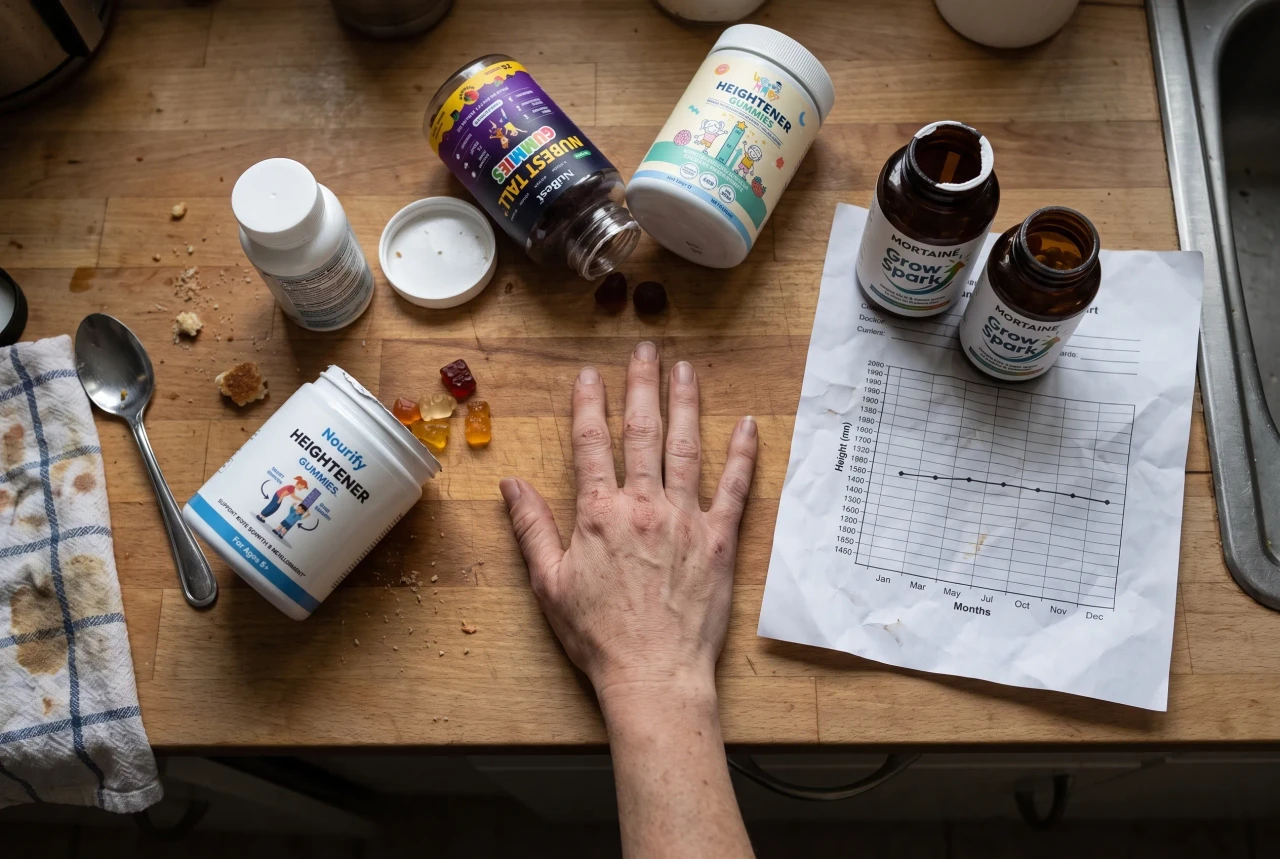
NuBest Tall Kids — $44.99/month for 8 months. Thousands of Amazon reviews. Label said "bone growth support." Ethan took it every morning. Eight months later — same percentile. Exactly the same. Sarah didn't say anything in the car that time. She just drove. Total: $359.92.
Wondernest Growth Gummies — $49.99/month for 5 months. She switched after reading that ashwagandha "supports growth hormone." She didn't know the Reddit forums were already tearing the formula apart — parents calling it an overpriced multivitamin, nutritionists pointing out that ashwagandha is a cortisol reducer, not a growth agent. When I showed her those threads, she went quiet and said: "I feel like an idiot." She wasn't an idiot. She was a mother doing what any mother would do. Total: $249.95.
Extra milk. High-protein meals. Earlier bedtimes. Blackout curtains. A $180 sleep tracker. She restructured his entire diet and sleep routine. Did everything the books say. Percentile at his next checkup: the 7th. Two points of movement after a year of turning herself into a full-time nutritionist for a 9-year-old.
Pediatric endocrinologist — $375 out of pocket. Two hours of testing. Blood panels. Growth hormone. Thyroid. The result? "His levels are normal. He's just genetically small. There's nothing actionable unless he drops below the 3rd percentile." Genetically small. Translation: the medical system has nothing for your son until he gets short enough to qualify for injections that cost $10,000–$30,000 a year.
Total: $1,285.84. On solutions that never had a chance of working.
And I'm the one who should have known why.
Then Ethan Came Home and Went Straight to His Room.
The night everything broke was a Tuesday in October.
Ethan walked through the front door at 3:45. Backpack still on. Shoes still on. Walked past Sarah, past me, past the dog. Closed his door.
Sarah knocked twenty minutes later. "Hey buddy. Everything okay?"
"I'm fine."
If you're a parent, you know what "I'm fine" actually means.
She sat outside his door. Eventually, he let her in. It took thirty minutes.
A kid on his soccer team had started calling him "little guy." Not mean, exactly. Casual. The kind of nickname that sounds friendly but sticks to a child's identity like wet concrete.
"He says it like it's funny, Mom. But nobody laughs. They just look at me."
Then he said something I will hear for the rest of my life.
"Is that just what I am now? The little guy?"
He was 10.
Sarah held him. Told him height doesn't define a person. Told him everything a good mother is supposed to say.
Then she came downstairs and looked at me with flat, exhausted calm.
"James. You study this for a living. Twenty-two years. Why can't you fix this?"
I didn't answer.
Because I didn't have one.
The Answer Was Hiding in My Own Research.
I didn't sleep that night.
I sat surrounded by 22 years of published research on childhood skeletal development. Not supplement marketing. Not product labels. The actual published biology. Growth plate physiology. Endochondral ossification. Chondrocyte differentiation pathways.
And I asked the question I should have asked the first time Sarah came home with a bottle of NuBest:
Why doesn't a single product on this market address the biological process that makes bones grow LONGER?
Not stronger. Not denser. Longer.
Sitting there at 2 AM, it hit me.
Every growth gummy on the market — every product Sarah bought, every formula I'd reviewed — was targeting the wrong biological process.
Every single one.
The $2.3 Billion Lie
Here's what I knew from 22 years of research that no growth supplement company has ever explained to you:
Strengthening a bone is NOT the same as lengthening it.
These are two completely different biological processes. Different parts of the bone. Different nutrients. Different outcomes.
Bone DENSITY is what happens when calcium, Vitamin D, and minerals deposit into existing bone tissue. The bone gets harder. Stronger. Every growth gummy on the market — NuBest, WonderNest, Grow Spark — is formulated for this process.
But bones do not grow LONGER by getting denser.
That's like saying you can make a building taller by reinforcing the floors that already exist. You can't. You need to add new floors.
New floors get built at one location: the growth plates — areas of developing cartilage near the ends of your child's long bones.
This process requires three things simultaneously:
STEP 1 — THE SIGNAL. Growth plates need a hormonal signal — driven by IGF-1 and growth hormone — to activate. Without it, growth plates sit dormant. Materials arrive. Nothing gets built. Every growth gummy skips this step entirely.
STEP 2 — THE CONVERSION. This is the step that physically makes bones LONGER. And the entire industry ignores it. Activated cartilage cells at the growth plate must differentiate — convert from cartilage into new bone tissue that adds LENGTH. This process is driven by Vitamin A in its bioavailable, fat-soluble form. Not a single top-selling growth gummy includes Vitamin A for this purpose. Not NuBest. Not WonderNest. Not Grow Spark. The most critical step in the entire growth process — the one that physically lengthens bone — and the industry acts like it doesn't exist.
STEP 3 — THE DELIVERY. Calcium needs Vitamin K2 as MK-7 to activate osteocalcin and direct minerals into new bone tissue. Without K2, calcium enters the bloodstream and floats. Most growth gummies dump calcium and D3 and stop here. They partially address one step out of three. And your child's growth chart stays flat.

Why the Industry Sells the Wrong Process
The reason is economics.
Calcium and D3 are the cheapest raw materials in the supplement industry. A month's supply of calcium gummies costs less than $2 to produce. Slap "supports growth" on the label. Charge parents $45.
Addressing the actual growth plate activation pathway costs significantly more. It requires ingredients most gummy manufacturers don't stock. It requires a formulation team that understands growth plate biology, not just bone density.
And it requires telling parents the truth: that bone health and bone growth are different processes, and the product they've been buying targets the wrong one.
No supplement company with shareholders is going to make that announcement.
So they keep selling calcium gummies with growth marketing on the label. Parents keep buying. Growth charts keep staying flat. Mothers keep crying in parking lots wondering what they're doing wrong.
Nothing. They're doing nothing wrong.
They were sold the wrong biological process.
The Protocol That Was Abandoned Because It Didn't Taste Like Candy
Before modern pharma, Scandinavian governments mandated cod liver oil supplementation for children.
Not a trend. Not a fad. A government-backed public health protocol.
Published medical texts from the 1800s documented its role in childhood skeletal development. It was distributed in schools and prescribed in hospitals for over a century.
And childhood growth stunting virtually disappeared in the countries that adopted it.
Norwegian men are consistently among the tallest on earth — nearly 4 inches taller than the average American male. The Dutch went from one of Europe's shortest populations to literally the tallest in the world in a few generations.
The gene pool doesn't shift that fast. Genetics didn't change. Nutrition did.
What made cod liver oil effective was its naturally occurring combination of Vitamins A and D in whole-food, fat-soluble, bioavailable forms — the exact nutrient profile that drives Steps 1 and 2 of the growth plate activation pathway. The signal AND the conversion.
Then modern pharma replaced it. Stripped the bioavailable nutrients. Substituted synthetic isolates. Cheaper. Easier. Packaged in colorful gummies children wouldn't refuse.
But the body processes synthetic isolates differently than whole-food fat-soluble nutrients.
And the growth plate activation pathway that Scandinavian children received for over a century was abandoned.
Not because it stopped working.
Because it didn't taste like candy.

What Happened After I Built the Formula Sarah Asked Me For
After that Tuesday night, I spent 14 months building what should have existed all along.
Not a bone density product with growth marketing on the label. A formula engineered to address all three steps of the growth plate activation pathway — using bioavailable forms of the same nutrient profile that Scandinavian health systems mandated for over a century.
Eleven formula iterations. Three rounds of third-party testing.
I gave the first bottle to Sarah for Ethan. Told her to mark the doorframe. Expect nothing for 90 days.
She didn't believe it would work. I could see it in her eyes.
Ninety-three days later, she measured again.
The mark had moved.
She stared at the doorframe for a long time. Then turned and looked at me.
She didn't say anything. She didn't have to.
Sarah mentioned it in her parenting group. Within two months, three mothers had ordered. All three reported movement.
Then my colleague David — a nutritional biochemist whose daughter had been stuck in the 9th percentile for three years — asked me about it. Six weeks later, he texted me at 11 PM: "Her pants don't fit. My wife is crying. The good kind. What is in this formula?"
A pediatric nurse David's wife connected with tried it for her own son — stuck at the 4th percentile. After 90 days she messaged me directly: "I measure kids for a living. My son jumped four percentile points. Why did nobody tell me bone density and bone growth are different processes? I went to nursing school. NOBODY MENTIONED THIS."
90-Day Doorframe Guarantee • Free Shipping
The First Growth Gummy Formulated for Growth Plate Activation
It's called Vastora Growth Activator.
It is not a multivitamin with height marketing on the label. It is not a calcium gummy that claims to "support bone health."
It is the first children's gummy formulated to address all three steps of the growth plate activation pathway — the process every other product either doesn't understand or has chosen to ignore.
Cod Liver Oil Extract (Vitamins A & D — Whole-Food, Fat-Soluble, Bioavailable) — The ancestral ingredient. Delivers the Vitamin A that drives chondrocyte differentiation — cartilage converting into new bone LENGTH at the growth plate. No other growth gummy includes this.
Vitamin K2 as MK-7 — Activates osteocalcin to direct calcium INTO growing bone tissue. Without K2, calcium floats through the bloodstream. MK-7 stays active longer than MK-4, completing the mineral delivery that competitors only partially address.
Bioavailable Zinc (Picolinate) & Magnesium (Bisglycinate) — Not cheap oxide forms that absorb at 4%. Bioavailable forms that support the hormonal signaling pathway and structural integrity of growing bone.
Glycine — Growth plates are cartilage. Cartilage is collagen. Collagen synthesis requires glycine. Competitors load calcium for harder bones. But bones grow longer through cartilage growth plates — and cartilage needs different building blocks than hard bone tissue.
Third-party tested. GMP-certified. No artificial dyes. No synthetic fillers.
Two gummies a day. That's the entire routine.
Exactly What Happens. Week by Week.
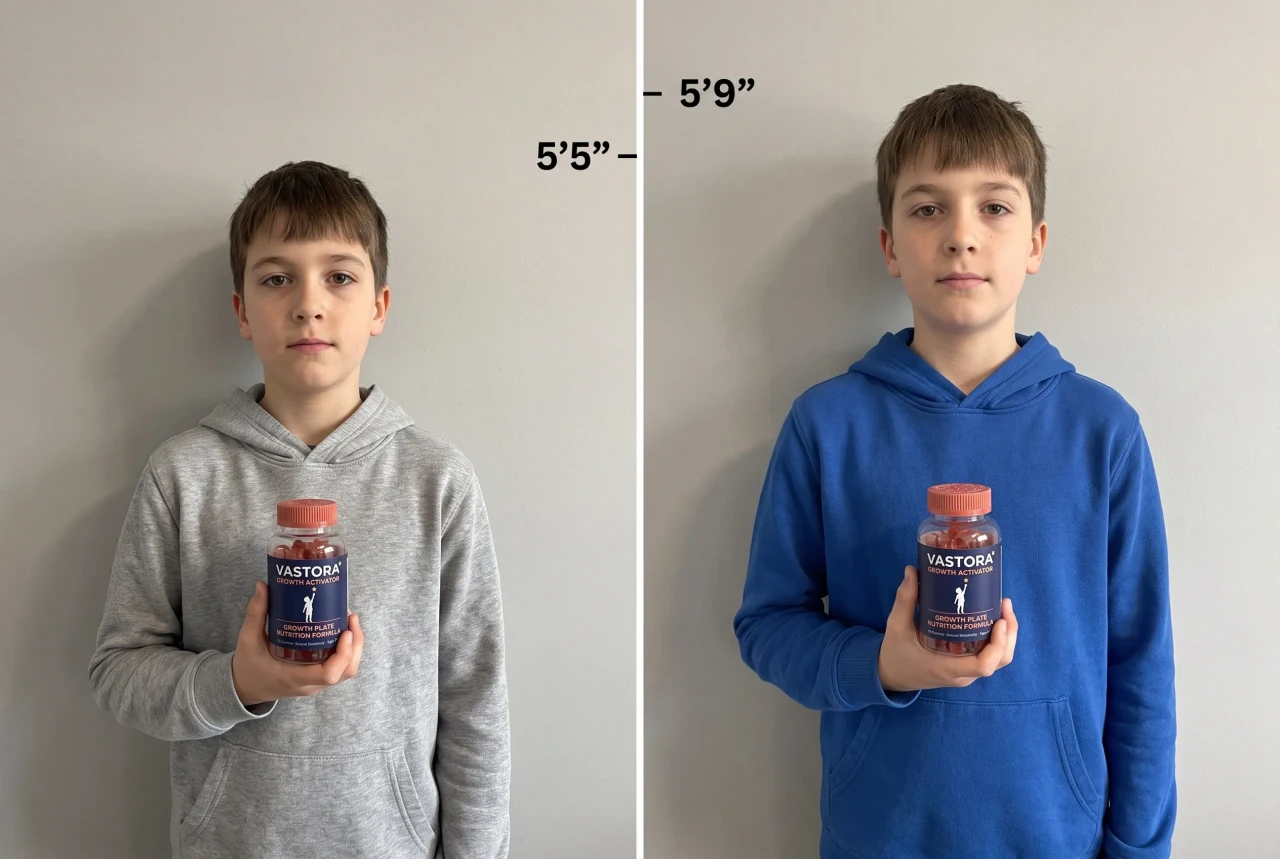
Week 1–2: The first thing most parents notice is sleep. Glycine and magnesium support deeper sleep cycles — and growth hormone releases primarily during deep sleep. Your child sleeps more soundly. Falls asleep faster. This isn't a side effect. Growth hormone secretion during deep sleep is Step 1 beginning to function. Sarah noticed on Day 4. She came downstairs and said, "He slept through the entire night. He hasn't done that on a school night in months."
Month 1: Chondrocyte differentiation begins receiving the Vitamin A signal. Some parents report the first subtle movement on the doorframe — not dramatic, but measurable. When Sarah measured Ethan at Day 30, she called me into the hallway. Pointed at the mark. Mouthed: "Is this real?" It was.
Months 2–3: Pants getting shorter. Sleeves pulling up. The pediatrician's ruler showing numbers it hasn't shown before. And the moment every mother in this situation is quietly praying for — someone else notices without being told. For us, it was Sarah's mother. She hadn't seen Ethan in five weeks. Walked in for Sunday dinner and before she took off her coat: "Wait. Has he grown?" Nobody had said a word.
Months 4–6: The gap narrows. Steadily. Measurably. And something the growth chart doesn't measure: the kid who'd been pulling away starts coming back. The "I'm fine" gets replaced with actual conversation. He stands straighter. Not because someone told him to — because he doesn't feel like he needs to hide anymore. Ethan tried out for the basketball team in January. He didn't make the starting lineup. But he made the team. He didn't say "I'm fine." He said "I made the team, Dad."
What Happened When the Industry Found Out
I want to be transparent.
Since Vastora started getting attention, a representative from one of the largest children's supplement brands — I won't name them, but their product is in every Target and Walmart in America — contacted me through an industry connection.
"The bone density vs. bone growth distinction is going to confuse parents. It's irresponsible messaging."
I responded with four published studies on endochondral ossification and chondrocyte differentiation.
Never heard back.
Then our ads started getting reported. Repeatedly. By accounts that appeared affiliated with competing brands. The ads passed every review — but the pattern was clear.
An industry built on selling bone density products to worried parents does not benefit from those parents learning that bone density and bone growth are different processes.
They can't argue with the science. So they try to bury the messenger.
My response is this page.
What This Actually Costs
NuBest: $44.99/month. Wondernest: $49.99/month. Average time parents stay before giving up: 6–12 months. Average total: $300–$600. On products that target the wrong process.
Endocrinologist consultation: $250–$400. GH therapy (if your child even qualifies): $10,000–$30,000/year. Daily injections. Only available below the 3rd percentile.
The average mother's total "tried everything" cost: $800–$2,000+.
Vastora Growth Activator costs a fraction of what you've likely already spent on things that didn't work.
We're currently offering a limited-time discount with free bottles on every order — specifically so your child has uninterrupted supply through the critical 90-day window. Running out at week 6 and restarting at week 10 breaks the biological continuity the pathway needs.
One bottle is a start. Three months of uninterrupted support is where the doorframe mark moves.
90-Day Doorframe Guarantee • Free Shipping
The 90-Day Doorframe Guarantee
I know what you're thinking. You've been burned before.
So here's my promise in writing:
Try Vastora for 90 days. Measure your child when it arrives. Mark the doorframe. Write down the date. Measure again at 90 days.
If the mark hasn't moved — full refund. No questions. You don't need to return the bottle.
This formula targets the actual biological process that determines whether bones get longer. Either the growth plate activation pathway responds to proper nutritional support — the way it responded in every Scandinavian population that adopted this protocol — or you get every penny back.
There is no scenario where you lose.
Two Paths. One Window.
Path 1: Keep buying gummies that target bone density while the growth plate activation pathway goes unsupported. Keep hearing "be patient." Keep watching the lineup photos. You haven't tried everything. You've tried everything that targets the wrong process.
Path 2: Two gummies a day. 90 days. Mark the doorframe.
Growth plates close on a biological schedule — boys around 16–18, girls around 14–16. Once they fuse, no supplement, no treatment, no amount of money reopens them.
The window is open right now. What you do with it is the only decision that matters.
90-Day Doorframe Guarantee • Free Shipping
P.S. — Ethan is 12 now. 15th percentile — up from the 5th. Bone age scan shows growth plates still wide open. He made the basketball team. Nobody calls him "little guy" anymore. Sarah hasn't cried in a parking lot in a long time.
P.P.S. — If you verify everything — good. Look up endochondral ossification. Chondrocyte differentiation and Vitamin A. The Scandinavian cod liver oil protocol. The Dutch height transformation. Everything on this page is independently verifiable. The science isn't hiding. The industry has just been selling you the wrong process.
90-Day Doorframe Guarantee • Free Shipping
Frequently Asked Questions
90-Day Doorframe Guarantee • Free Shipping